
There are mornings when you wake up on a sailing boat and immediately start thinking about wind direction, tides, weather forecasts and where you might get to before dark.
This was not one of those mornings.
After the long afternoon getting into Barbate, neither of us was particularly interested in sailing anywhere.
La Sirena was tied up. Nothing appeared to be leaking. Nothing was making a noise it shouldn’t be making. The mast was still pointing upwards.
As far as we were concerned, this represented an extremely successful start to the day.
“We’re not moving today, are we?” Liam asked.
“No.”
“Good.”
And that was the entire passage-planning meeting.
First priority: coffee
Life on a boat does strange things to your priorities.
At home, making coffee is not an achievement. You walk into the kitchen, press a button and approximately thirty seconds later you’re drinking it.
On a boat, coffee involves water tanks, gas, balancing things on a stove and keeping one eye on anything that might suddenly slide across the galley.
But this morning even that seemed unnecessarily ambitious.
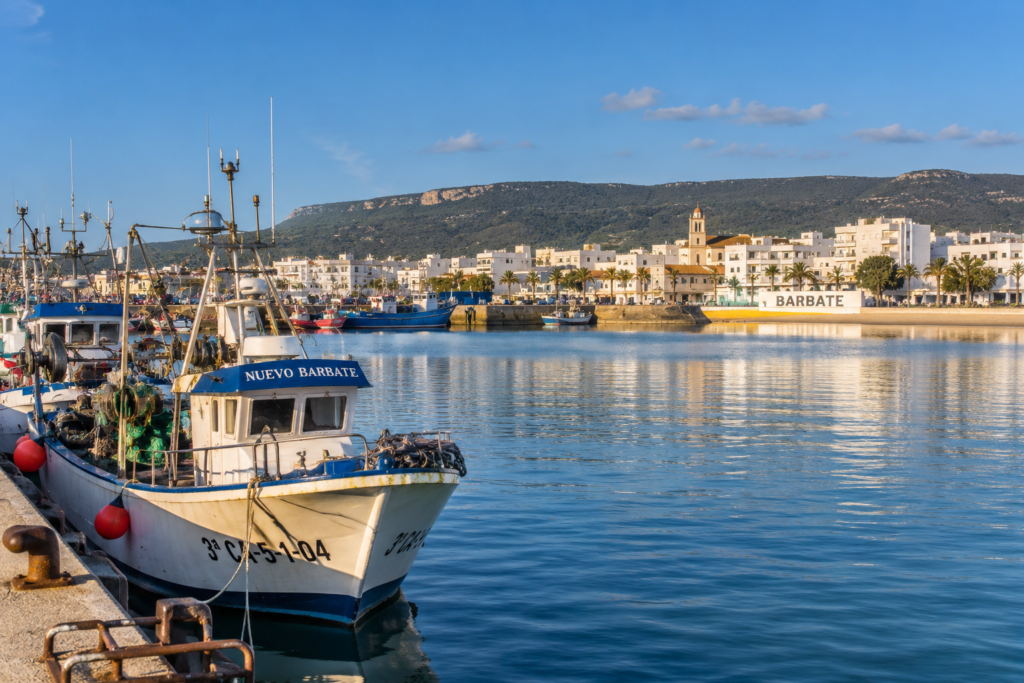
We could see Barbate beyond the marina.
Somewhere over there were cafés.
So we abandoned La Sirena and went looking for breakfast.
One of the things we’d already noticed about Barbate was that it felt different from some of the places we’d stopped farther up the Spanish coast. We’d spent time exploring Cádiz on foot after sailing in, but Barbate had a very different feel.
This was very obviously a working town.
Fishing boats sat around the harbour. Nets and equipment occupied spaces that in a more touristy marina would probably contain expensive outdoor furniture. There were gulls everywhere, watching proceedings with the air of creatures who considered themselves senior management.
Barbate has been shaped by fishing for generations and you don’t need to read a sign to work that out.
The place smells of the sea.
Not the pleasant candle-shop version of “sea breeze”.
Actual sea.
Fish. Salt. Diesel. Boats.
We liked it immediately.
A town built around tuna
After coffee and something involving far too much bread, we started walking.
We didn’t really have a plan.
This is generally how our best days ashore begin.
Barbate is famous for bluefin tuna and particularly for the almadraba, the traditional method of catching tuna as they migrate through these waters towards the Mediterranean.
The system uses a maze of anchored nets positioned offshore to intercept the fish during their migration. Versions of the technique have been used around this coast for thousands of years.
We knew almost none of this when we arrived.
By lunchtime, Liam had become an expert.
This happens regularly.
Give him twenty minutes and an information board and he develops the confidence of someone preparing to deliver a university lecture.
“The clever thing about the almadraba,” he explained, “is where they position the nets.”
“You learnt that five minutes ago.”
“Doesn’t make it less true.”
Apparently not.
The more we wandered around Barbate, though, the more interesting it became.
For sailors, there’s something particularly appealing about towns that still make their living from the sea. We’re travelling along this coast for fun. For generations of families here, the Atlantic has meant work.
And tuna isn’t some little historical curiosity they’ve kept alive for visitors.
It’s everywhere.
Restaurants advertise it. Shops sell it. There are businesses devoted to processing it. Even the town’s public art reminds you of it.
Eventually, all this discussion about tuna produced the inevitable result.
We got hungry.
The world’s least scientific tuna tasting
Choosing lunch in Barbate when you know absolutely nothing about tuna is surprisingly difficult.
We are familiar with tuna in Ireland.
It normally comes in a tin.
Occasionally, if you’re feeling sophisticated, it comes in a sandwich with sweetcorn.
Barbate takes a rather different approach.
There are numerous cuts from different parts of the fish and locals appear to understand distinctions that were entirely lost on us.
We stared at the menu.
Liam pointed at something.
“That’s the one.”
“Why?”
“Best cut.”
“How do you know?”
“I can tell.”
He could not tell.
We ordered several things anyway.
This turned out to be an excellent decision.
There are meals you remember because the restaurant was fancy or the view was spectacular.
Then there are meals you remember because you’re sitting outside somewhere you didn’t know existed a few months earlier, eating ridiculously good food with a cold beer while your boat waits in a harbour around the corner.
This was the second kind.
The tuna was superb.
Another beer arrived.
We had originally planned to spend part of the afternoon doing jobs on La Sirena.
This now seemed increasingly unlikely.
“There’s no point rushing back,” Liam said.
“We’re not rushing.”
“Exactly.”
Another beer arrived.
Boat maintenance had officially been postponed.
Absolutely essential maritime research
By mid-afternoon we had developed a highly effective shore-day routine.
Walk for a while.
Stop somewhere.
Order something cold.
Discuss the boat jobs we definitely intended to do later.
Walk somewhere else.
Repeat.
It wasn’t hugely different from the approach we’d adopted during our land day in Lisbon, although Barbate involved considerably fewer hills.
Eventually we reached the seafront and Playa de Nuestra Señora del Carmen, Barbate’s main urban beach.
After weeks of travelling by boat, you’d think we’d be sick of looking at the sea.
We’re not.
The strange thing about sailing is that being beside the sea and being on the sea feel completely different.
From La Sirena, the water is something we’re constantly thinking about.
Depth.
Wind.
Swell.
Currents.
Anchorages.
Rocks.
Other boats.
Things that can break.
Things that have already broken.
Standing on a beach with no responsibility whatsoever is different.
You can just look at it.
The Atlantic stretched out in front of us and somewhere beyond the horizon was everything we’d already sailed past.
Portugal.
Cádiz.
All those miles south.
It was one of those moments when the trip suddenly felt real again.
We’d had days when the Atlantic had been anything but relaxing, particularly off Cape St. Vincent. Sitting on a beach in Barbate looking back towards all those miles we’d already covered felt slightly surreal.
Then Liam went swimming.
I watched.
One of us clearly has better survival instincts.
The jobs we didn’t do
Back at the marina later that afternoon, La Sirena was exactly where we’d left her.
Always reassuring.
We climbed aboard and immediately began pretending we were going to accomplish something.
There is an unwritten rule of boat ownership that whenever you return after a day ashore, you should spend at least five minutes looking thoughtfully at ropes.
You don’t actually have to adjust anything.
You simply stand there with your hands on your hips and inspect them.
This demonstrates seamanship.
I checked a line that absolutely did not need checking.
Liam moved something from one side of the cockpit to the other.
Productivity achieved.
Then we sat down.
The marina had become quieter and the heat of the day was beginning to disappear. Fishing boats were coming and going around the harbour while gulls continued whatever organised-crime operation gulls conduct in every fishing port in Europe.
It would have been a perfect moment to tackle the list of maintenance jobs.
Instead, we opened two beers.
Tomorrow.
Everything could happen tomorrow.
Then we looked at the chart
This is the dangerous part.
Eventually, on every rest day, somebody looks at the chart.
For weeks our journey had been simple enough.
Keep heading south.
Then keep heading south some more.
We’d left Porto for the long haul towards Lisbon, worked our way around the Portuguese coast and eventually reached Cádiz.
Now Barbate felt different.
Because the next bit was sitting there.
Tarifa.
And beyond Tarifa, the Strait of Gibraltar.
When we first set off aboard our 35-foot Beneteau Oceanis 351, La Sirena, places like Gibraltar seemed impossibly distant.
They were lines on a chart.
Milestones.
Things we’d worry about later.
Except suddenly, later was becoming tomorrow.
Or the day after tomorrow.
From Barbate, we were getting close.
The Atlantic part of the adventure wasn’t quite finished, but we could almost see the doorway into the Mediterranean.
And doorways have a habit of being windy.
The Strait funnels air between Europe and Africa. Add current, shipping and the fact that neither of us possesses an overwhelming desire to become a cautionary tale and there would be rather more planning involved than usual.
Not tonight though.
Tonight we were staying in Barbate.
La Sirena was secure.
The beers were cold.
We’d eaten an unreasonable quantity of tuna.
And for once, absolutely nothing on the boat required immediate attention.
As sailing days go, it was difficult to improve on.
Tomorrow we’d check the weather.
Tomorrow we’d think about Tarifa.
Tomorrow we’d start worrying about the Strait of Gibraltar.
But today?
Today we had successfully sailed nowhere.
And sometimes that’s exactly what you need.
