
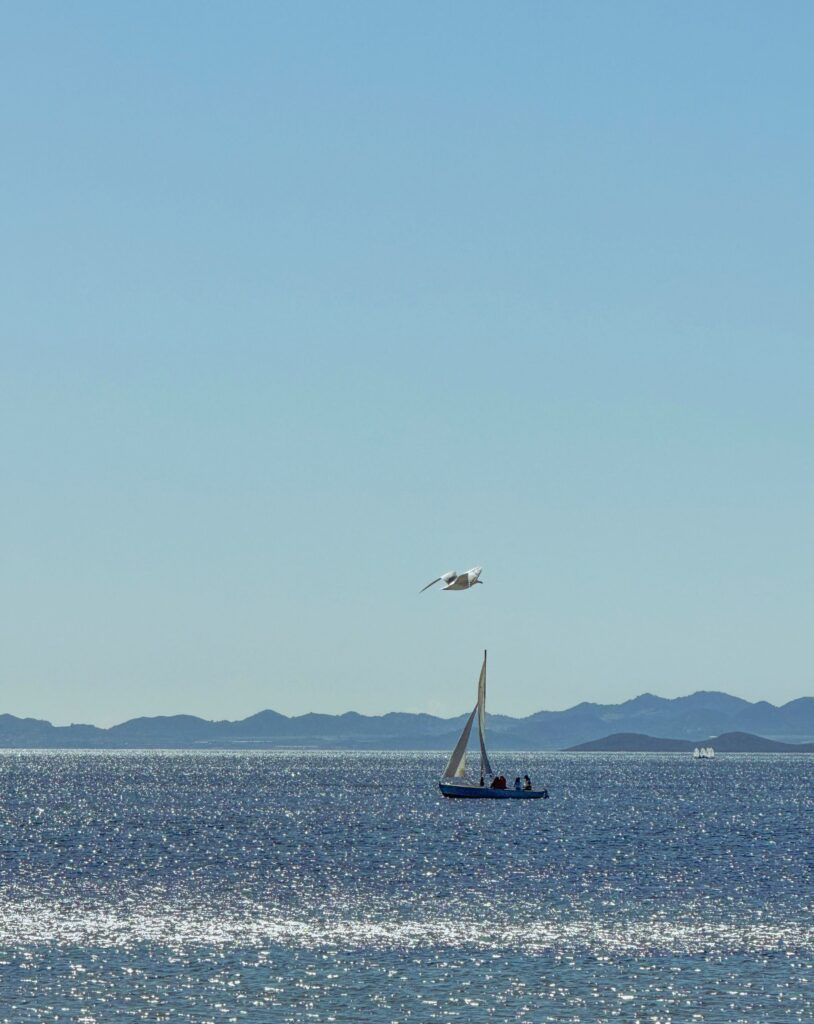
We left Cádiz at lunchtime, which was not the plan.
The plan had involved dawn, coffee in travel mugs and the sort of efficient departure that makes you feel briefly competent.
Instead, we had spent the morning staring at a battery monitor, buying a replacement part and watching other boats leave without us.
By the time the lines came aboard, the day already felt half used.
Liam took us out of the marina while I cleared the fenders and tried to find somewhere to put the shore-power cable. Cádiz was bright behind us. The cathedral dome stayed visible for longer than I expected, sitting above the buildings as the harbour widened.
“You trust the batteries?” I asked.
“No.”
“Good.”
“I trust them more than I did three hours ago.”
That was apparently enough.
The engine settled into its usual rhythm. Nothing beeped. Nothing smelled hot. The battery monitor showed a sensible number and continued showing it every time one of us checked.
We checked it often.
Once we were clear of the harbour, the wind was lighter than forecast. There was enough to lift the mainsail but not enough to do much with it. We kept the engine running and let the sail take some of the load.
The coast south of Cádiz looked flatter from the water. Long beaches, low buildings and a line of land that seemed to stretch without giving much away.
Barbate was the target.
It wasn’t a heroic passage. On a chart it looked like an afternoon run down the coast. The sort of leg you mention quickly when telling somebody about the journey later.
That didn’t stop us treating it like an Atlantic crossing.
Liam checked the weather again.
I checked the batteries.
He checked the engine temperature.
I checked whether we had enough coffee.
All satisfactory.
For the first hour, neither of us said much. Leaving somewhere after a longer stop always feels slightly strange. Cádiz had become familiar. We knew which shower worked properly, where to buy bread and which route through the marina avoided the bins in the heat.
Then the city began to disappear and the boat became our whole world again.
A few miles down the coast, the wind arrived.
Not dramatically. It just filled in from behind us and stayed there.
We shut the engine down.
The sudden silence was lovely.
La Sirena moved along at a steady pace with the mainsail and genoa pulling together. The water flattened a little closer to shore and the boat found a comfortable angle.
Liam looked at the instruments.
“Five knots.”
“Actual five knots or optimistic five knots?”
“Five point two.”
“Definitely optimistic.”
He ignored me.
We had spent most of the morning trying to leave. Now that we were moving, there was nothing much to do. Cádiz fell out of sight. Barbate was still too far ahead to see and the coast passed slowly on our port side.
I made sandwiches below.
The battery monitor caught my eye on the way back up.
The number had dropped.
Not far. Just enough.
I stood looking at it for a few seconds, hoping it might correct itself.
It didn’t.
“Liam.”
He leaned into the companionway.
“What?”
“The batteries.”
His face changed.
That was the problem with the morning’s repair. Before Cádiz, a small change on the monitor would barely have registered. Now every movement looked like the beginning of another day trapped beside a chandlery.
Liam came below and switched off the fridge.
The number steadied.
We turned the fridge back on.
It dipped again.
“That’s normal,” he said.
“You sound very confident.”
“It is normal.”
“You weren’t saying that this morning.”
“This morning it dropped like a stone.”
We watched for another minute.
Nothing happened.
The batteries were behaving exactly as batteries behave when they are no longer connected to shore power and are being asked to run things.
We had frightened ourselves with a working electrical system.
Liam went back to the cockpit.
I followed with the sandwiches.
“Good repair,” I said.
“Excellent repair.”
“Never doubted it.”
He gave me a look and took the larger sandwich.
By late afternoon the wind softened again. We started the engine and rolled away the genoa. The sea had picked up a short, awkward swell that caught us slightly from the side. Not enough to be difficult, just enough to make every loose item below begin tapping against something else.
There is always one noise you cannot find on a boat.
This one sounded like a spoon inside a cupboard.
I checked the cutlery drawer.
Nothing.
Then the tool locker.
Nothing.
The tapping continued.
“Can you hear that?” I asked.
“No.”
“You can.”
“I’m choosing not to.”
I went below again.
The culprit was a small tin of tomatoes rolling backwards and forwards behind a saucepan.
I wedged a tea towel around it.
Silence.
Two minutes later another noise started near the bow.
I left that one alone.
Barbate appeared slowly. First the land changed shape, then the harbour wall became visible and finally we could make out the entrance.
Fishing boats were coming back in as we approached. They moved with purpose, crews already preparing lines and gear while we hovered outside checking the harbour plan for the fourth time.
Liam called the marina.
No reply.
He tried again.
Still nothing.
We entered slowly and found the visitors’ pontoon.
There was space at the end beside a motorboat. The wind had returned just enough to push us away from it.
I stepped off with the bow line, missed the first cleat and had to perform the short, undignified run familiar to anyone who has ever arrived at a marina while somebody was watching.
A man on the next pontoon caught the stern line.
“From Cádiz?” he asked.
“Eventually,” Liam said.
The engine went off.
The batteries still looked fine.
We connected the shore power anyway.
Barbate was quieter than Cádiz. The fishing boats were tied up across the harbour and gulls circled above the sheds. Beyond the marina we could see apartment blocks, a line of trees and the road into town.
Neither of us suggested leaving early the following morning.
We put the kettle on and left the battery monitor alone.
